
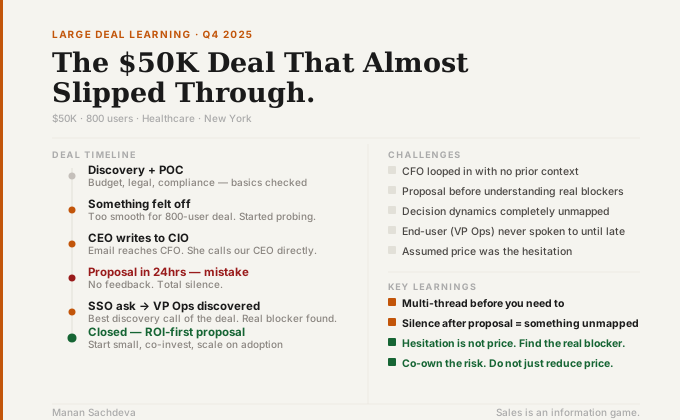
Last week of the quarter. My AE is at 80% attainment — this deal takes him to 120%.
$50K. A large healthcare company based in New York. 800+ users. The CIO running the evaluation.
We Did the Basics Right
Discovery was standard. We understood the critical event, confirmed budget allocation, mapped the buying process, and aligned on legal and compliance before even starting the POC. All the right boxes checked.
But it was going too smooth for an 800-user implementation. The AE and I both felt something wasn't adding up. We started probing the CIO on timelines a little more.
That's when things got interesting. We understood that post the compliance alignment, the range of budget we shared with the CIO was sitting at the CFO's desk.
Multi-Threading Between Execs
We dug into who the CFO was. She hadn't been involved in any of the discussions. During the research we figured there were actually two companies associated with this account, and the CFO seemed aligned to one of them. We still didn't know the full picture.
So we asked our CEO to write directly to the CIO. A personal note: he was ready to support this initiative, and wanted to know if there were any questions at the leadership level.
Boom.
That email found its way to the CFO. The CFO called our CEO directly, and jumped straight into sharing their budget. Keep in mind: at this point, we had shared a budget range with the prospect, but no formal proposal.
The Mistake We Almost Made
The CFO was suddenly in a hurry. And that was probably our first mistake, which we only realised later.
We did free consulting work and sent a formal proposal within 24 hours of the CFO discussion.
Predictable outcome: no feedback. Nothing.
You'd think a CFO calling a CEO would expedite a deal. It didn't.
Back to the Drawing Board
We went back to basics and asked ourselves two questions: What don't we know? And what leverage do we actually have?
What we didn't know:
- No platform currently in play, and no clear critical event or hard timeline
- How close or far we were from their actual budget
- Who would make the final decision — the CIO kept pushing us toward the CFO, and the CFO was transactionally asking for a price. There were clearly some internal dynamics we hadn't mapped
- The legal process — the CFO had agreed to a 3-year contract but wanted an opt-out clause. Who would we work with to build that, and when?
Everything pointed to the same conclusion: we didn't understand enough.
Our leverage:
- A pending technical SSO implementation discussion
- One small detail buried in the CIO's email signature — he was going on a 10-day break in the next 7 days
The Move That Changed Everything
Instead of following up on the proposal again, we asked the CIO one question:
"Hey, it looks like you're heading on leave — with 1-2 days left in the trial, do you think we can go through the steps to configure SSO for your account to avoid any hiccups later?"
He said yes. And then, almost as an afterthought, asked: "Can we get a trial extension?"
Now we had to play this carefully.
Yes, let's schedule the SSO call. We typically do 4-5 day extensions — does that work? But we were curious: what functions still needed to be tested?
That question was probably the game-changer.
Because after that, he looped in another VP — someone we had never spoken to until this moment. An Ops leader. A completely new stakeholder.
We scheduled two separate calls: one for SSO, one to understand what the Ops lead needed to evaluate.
The second call turned out to be the most productive discovery conversation in the entire deal. Because this was the head of the team who would actually be deploying this for 800 people.
She told us everything.
The hesitation wasn't really about price. It was about ROI justification. Their real concern: what if we invest this much upfront and 800 non-technical users don't actually use it?
That was the most important piece of information we'd received in the entire deal cycle.
The Real Lesson
Most salespeople assume that when someone is hesitant on price, you discount. Here, the problem was entirely different — and discounting would have solved nothing.
Once we understood that, we had the leverage to act as consultants. To bridge the gap between Ops and the CFO. To recommend a path that let them justify ROI rather than just reduce price: start small, co-invest in user training, then scale up once adoption is proven.
We are a smaller vendor, and we will do everything possible to make you successful — and we will co-own the risk. That was the story we had to play out.
Sales is an information game.
The reps who win are the ones who collect information from multiple sources — by asking better questions, building better judgement, and thinking through different scenarios. When you have the right information, your actions align to where the prospect actually is today. Not where your quarter is ending.